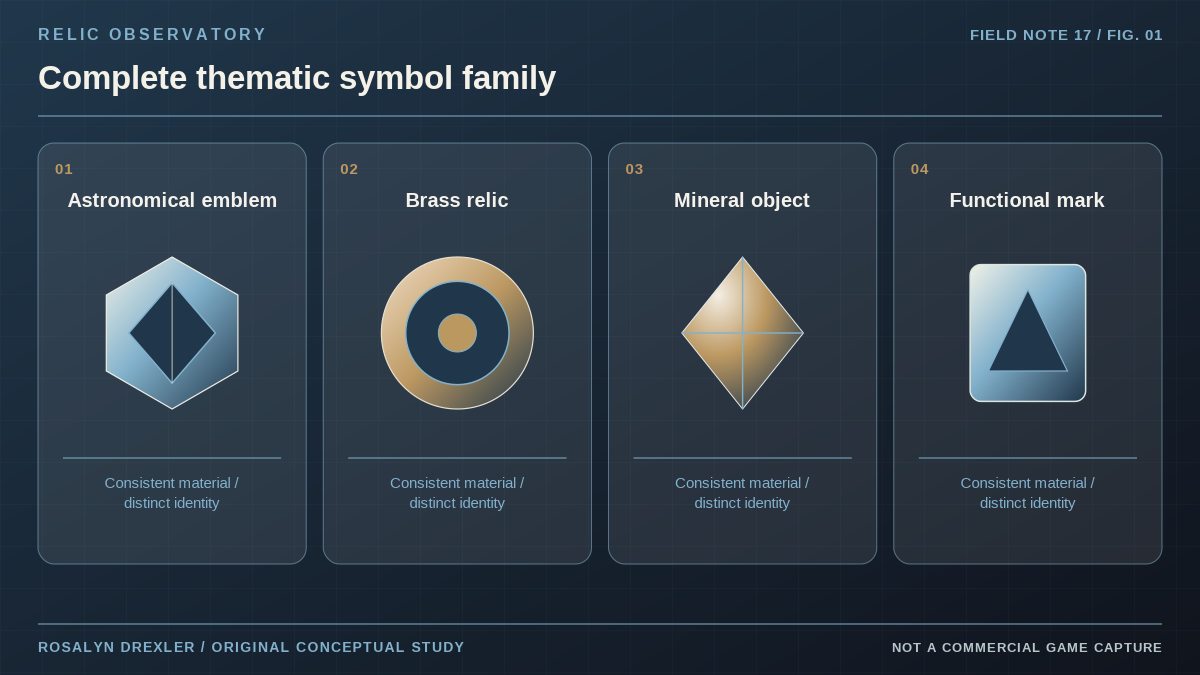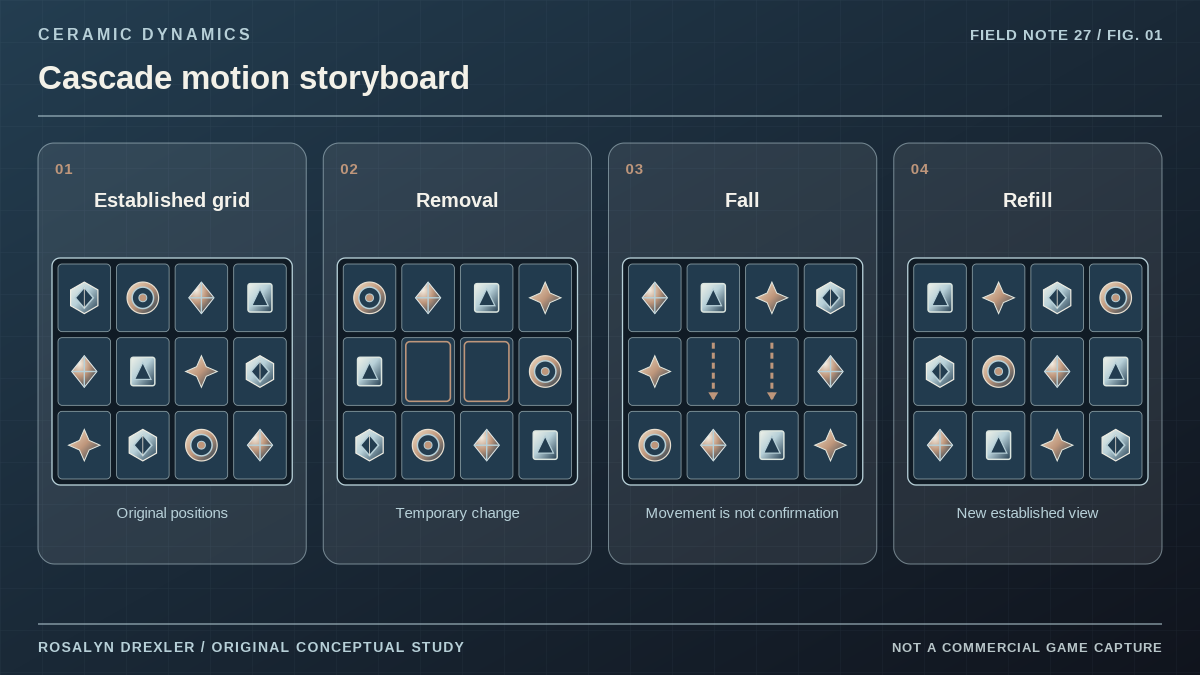
Wild symbol animation design is concerned with visual states of a symbol whose documented role differs from ordinary artwork. A transformation can change its appearance or visible extent, but a coherent presentation should preserve the distinction between the object's established meaning and temporary decorative effects. This article treats the game rule as reference material, not the subject of the design guide. The fictional gold-medallion illustrations show baseline, transitional and established treatments without reproducing a commercial game asset.
Visual language for wild symbol states
The art system should define a wild symbol's recognizable identity before animation is introduced. A baseline illustration may contain an explicit letter, emblem or other functional identifier. Its treatment should remain distinguishable from ordinary symbols at the sizes supported by the interface. A state library can record the appearance of the original object, any transitional presentation and the established changed condition.
Silhouettes, glow, overlays and hierarchy
Silhouette and functional identity. A recognizable external contour and a readable internal identifier can communicate identity independently of decorative glow. When the symbol has several states, avoid changing all of its recognizable properties at once without providing a clear equivalent identifier. Compare the artwork in full color, monochrome and small-scale views. See slot game symbol design for static asset families and silhouette inspection.
Glow and layered effects. Decorative illumination can emphasize an object, but it should not be the sole indicator of its function. A glow may become less distinct against bright artwork or may extend into neighboring positions. Separate the essential state outline and label from optional particles, reflections and background illumination. In a production file, those layers should be distinguishable and have documented roles.
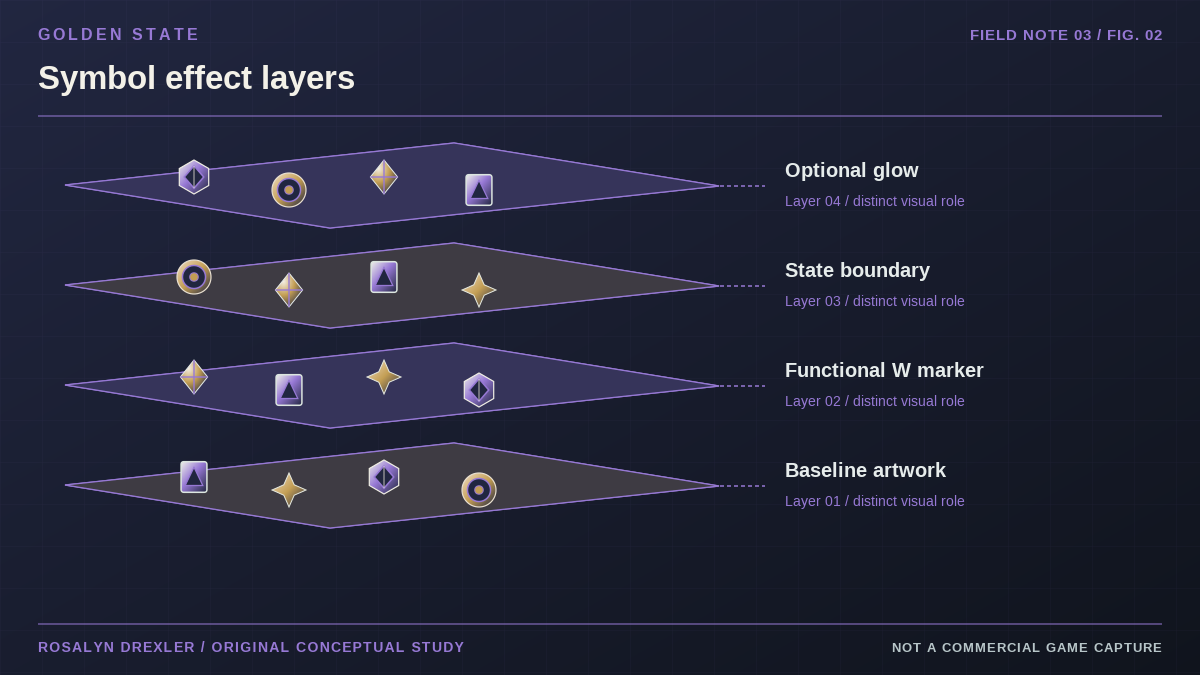
Overlays and information hierarchy. An overlay may communicate a changed spatial region or contextual condition. Its boundaries should correspond to the actual established information. Check that underlying symbols, relevant numbers and unrelated controls remain readable. A visual treatment should not imply a financial gain merely because it appears more elaborate than the baseline symbol. Explicit result information must communicate the actual meaning.
Designing expansion motion and transitions
Expansion and transformation introduce a relationship between the object's original appearance, temporary presentation and subsequent established state. A motion storyboard should identify these phases using state names rather than assume that a specific decorative frame corresponds to a confirmed system event. A useful specification contains the state indicator, optional motion layers, affected visual boundaries and information that must remain available.
Timing, anticipation and mobile legibility
Timing and anticipation. A visual transformation may require time to display, but essential information should not become inaccessible after the animation concludes. The presentation must not imply that an unresolved outcome has been established. See anticipation animations for the distinction between pre-result cues and confirmed feedback. No universal duration is appropriate for every symbol, viewport or motion complexity; use recorded evidence to evaluate legibility.
Mobile legibility. Inspect the smallest supported symbol rendering against representative backgrounds. A detailed particle treatment may obscure the functional identifier at a reduced size. If an expanded graphic overlaps the edges of the display, verify that its boundaries do not cover financial labels or controls. A simplified treatment should retain the same information-bearing outline and status. The relationship between multiple changing symbols is covered in cascading reels animation design.
Interruption scenarios. Test an interrupted transformation, an orientation change and a return from a backgrounded application. Established information should remain correct if the decorative effect is shortened or unavailable. Where the system state is unresolved, the interface should report that status explicitly. An animation ending is not evidence of a completed transaction. Document the visual recovery requirements alongside the ordinary storyboard.
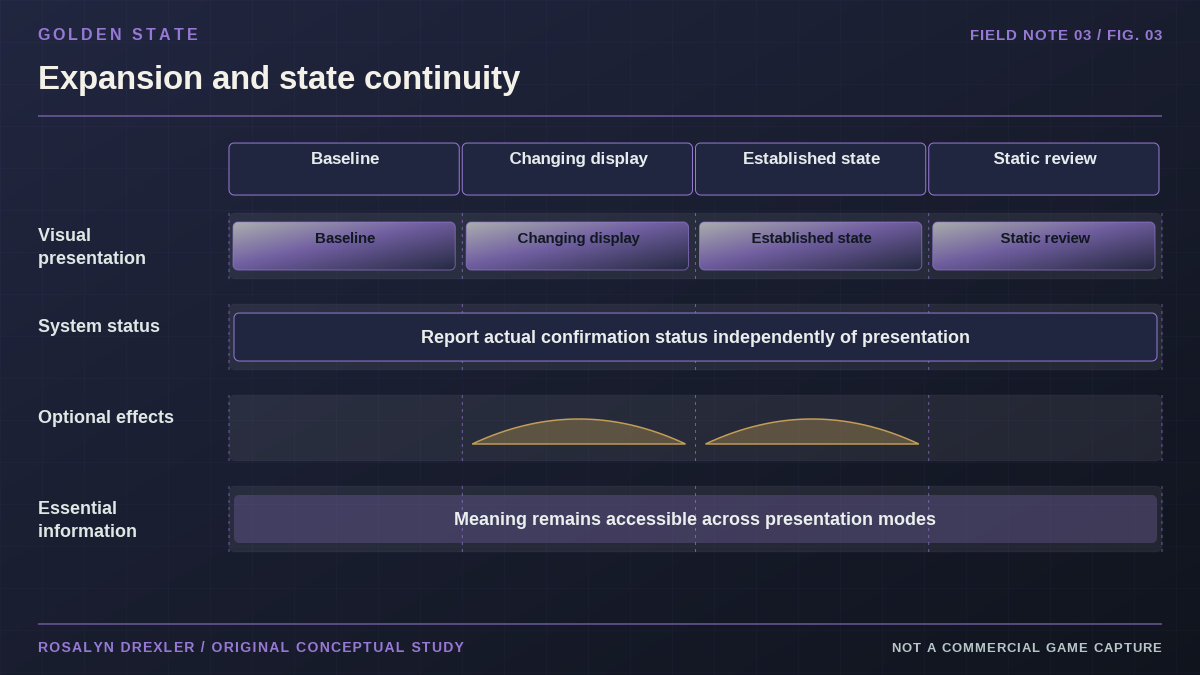
A transformation specification. Document the identity of the baseline asset and the graphical property that changes in each supported state. For the fictional gold medallion, the recognizable central emblem belongs to the object identity, while an additional outer boundary can represent an established changed condition. Reflections, particles and decorative light belong to optional artistic treatment. This separation allows a motion designer to change a reflection or simplify the illumination without unintentionally removing the information-bearing boundary. It also gives the developer a clear distinction between source artwork and state-dependent presentation.
For a review frame, place the ordinary medallion, transitional artwork and established treatment at identical scale. Add an annotation naming the object in each frame and identifying the role of the surrounding visual layers. If a new shape represents a different established state, record that meaning in the reference documentation. If the surrounding glow is purely decorative, identify it as such. The review should not infer information from the brightness of an exported image. It should check the explicit state mapping agreed with the product team.
Accessibility and visual QA
Accessibility and visual QA should examine both individual assets and their complete presentation context. An approved high-resolution illustration may lose its distinction when placed against a textured background, reduced in size or combined with several simultaneous effects. Inspect actual rendering conditions and preserve a clear boundary between functional information and ornamentation.
Contrast, reduced motion and performance checks
Contrast and reduced motion. Check the actual foreground and background combinations, including temporary lighting changes. If the identifier is readable only when the glow is active, the baseline graphic requires review. A reduced-motion alternative should communicate the established state with an equivalent static outline, label or graphic. Audio should not be the sole means of identifying the changed state.
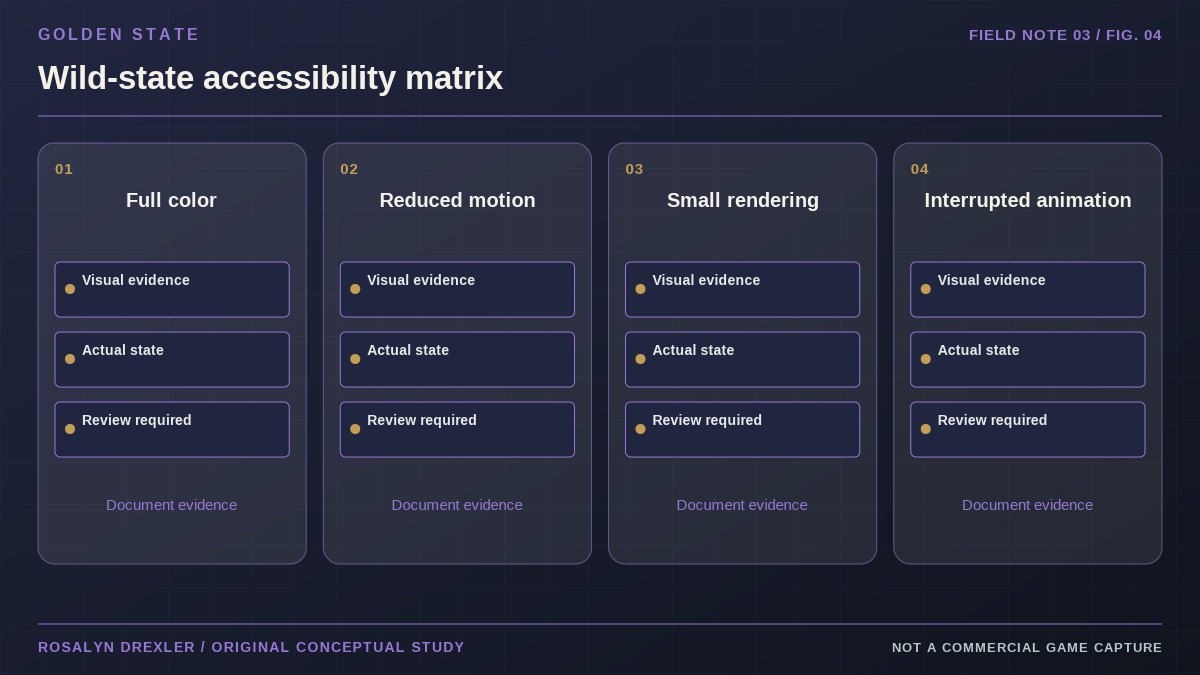
Performance and handoff. Separate source artwork, exported assets, essential state layers, decorative motion and implementation metadata. Test frame consistency and resource consumption on supported devices; do not infer measured performance from the number of visible particles. Review alpha edges, clipping, alignment and the appearance of neighboring information. An issue report should identify the actual state, viewport, settings, expected meaning and recorded evidence.
Asset acceptance example. A source-file review might approve the outline and identifier at the intended sizes but leave the contextual glow unapproved until the integrated interface is inspected. The reason is that alpha edges, background color and overlapping artwork can alter the apparent boundary. Record the relevant asset revision and display condition in the issue report. Separate an artwork problem, such as an inconsistent contour, from an integration problem, such as a mask cutting off the identifier. This makes responsibility and retesting clearer.
An alternative presentation should be accepted only when the information represented by the changed state can be identified without the full decorative sequence. Test that the same symbol and its established status are available in the ordinary view, the static view and a recovered view after interruption. If the implementation offers an accessible state description, verify its actual wording and association with the correct object. The review is complete when the relevant information is consistent, not simply when all animations look visually similar.
The transferable principle is that a wild animation should communicate the identity and established state of an object without depending on decorative intensity. The complete interface should remain understandable during ordinary, simplified and interrupted presentation. This is a design and production requirement, not an assessment of a particular game's financial characteristics.
Practical design QA checklist
Use this checklist as a review framework; it does not certify accessibility, performance or compliance.