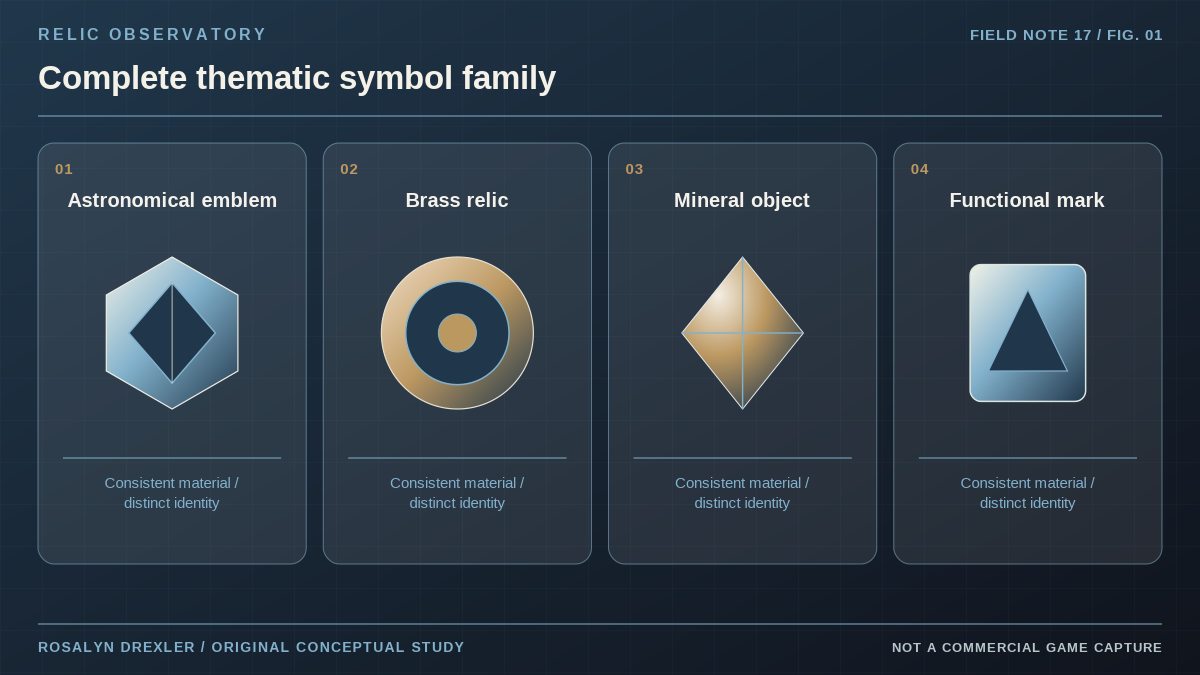
Slot game symbol design connects artistic identity, object recognition and documented functional roles. A coherent symbol family should belong to the same fictional world while retaining distinguishable individual shapes and meanings. This guide examines asset roles, silhouette, contrast, scaling and production handoff. The Relic Observatory visual studies use brass, slate and mineral materials as an original conceptual system, not a commercial game asset library.
Building a consistent symbol system
Begin with a documented inventory of the required symbol roles. A game rule defines the function; the art system defines how the corresponding object is represented. These responsibilities should remain distinguishable. The inventory should identify ordinary objects, special functional symbols, supported visual states, source artwork and technical export requirements. The goal is a coherent family rather than a collection of unrelated illustrations.
Premium, low-value, wild and scatter roles
Premium and low-value roles. Where the approved product documentation distinguishes symbol categories, the artwork can reflect those categories through consistent material and shape relationships. However, a more elaborate object should not independently imply a particular financial outcome. The reference information should communicate documented roles explicitly. Ordinary objects need recognizable identities even if they share common material treatments or color accents.
Wild and scatter roles. A special symbol can require a distinct functional identifier that remains readable at small sizes. The visual system should preserve its recognizable identity across supported states. If the object has an animated transformation, document baseline, transitional and established artwork separately. The wild symbol animation guide examines that dynamic state vocabulary. A static symbol inventory should not substitute for the actual rule description.
Artistic consistency. Define shared perspective, lighting direction, edge treatment, material behavior and detail density. These characteristics can connect a set of objects without making their silhouettes identical. An observatory-themed family might use brass frames, polished minerals and restrained astronomical engravings. Different objects can retain distinct outlines while using compatible reflections and material properties.
Functional labels. Names and reference descriptions should be consistent across the display and information screen. An illustration can support object recognition, but it should not be expected to explain every documented condition independently. If two states represent the same object, the relationship should remain clear through recognizable identity and explicit information.
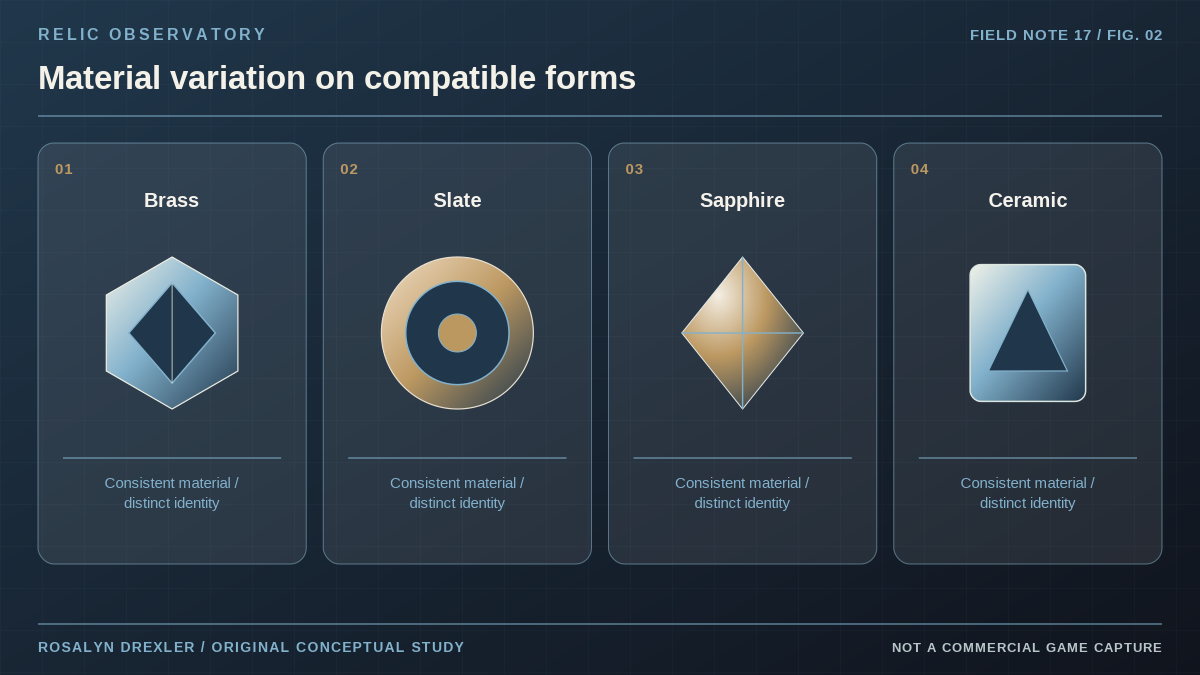
An asset-family specification. A complete symbol inventory should identify the approved role, name, artwork reference, supported states and corresponding information description for every object. This gives the art team and the implementation team a shared vocabulary. A label in the reference screen should refer to the same object identifier that appears in the display. If an asset has several visual treatments, the specification should explain which treatments preserve the same object identity and which represent a different documented condition.
Consider the fictional Relic Observatory family. It can include a faceted mineral, a circular brass medallion, an astronomical emblem and an engraved functional marker. These objects share a restrained material vocabulary and compatible lighting, but have visibly different contours and internal structures. A style sheet can document the relationship between materials, edge treatment and apparent scale. It should not assign financial meaning to artistic richness alone. The documented role and reference description establish the functional meaning.
A useful asset inventory also identifies variations that are permitted without changing identity. A different reflection or subtle material treatment may belong to the same approved object. A changed functional identifier may represent a different state and require a separate description. These distinctions matter when source illustrations are exported for ordinary, transformed or simplified presentation. Keep the approved source reference and state mapping accessible to every contributor.
Designing legibility and distinction
Asset legibility must be evaluated within the complete interface. Artwork that appears clear in a high-resolution source file may lose important distinctions when reduced, placed against a textured background or combined with illumination and neighboring objects. A systematic review separates external contour, internal structure, material detail and functional identifiers.
Silhouette, contrast and small-screen scaling
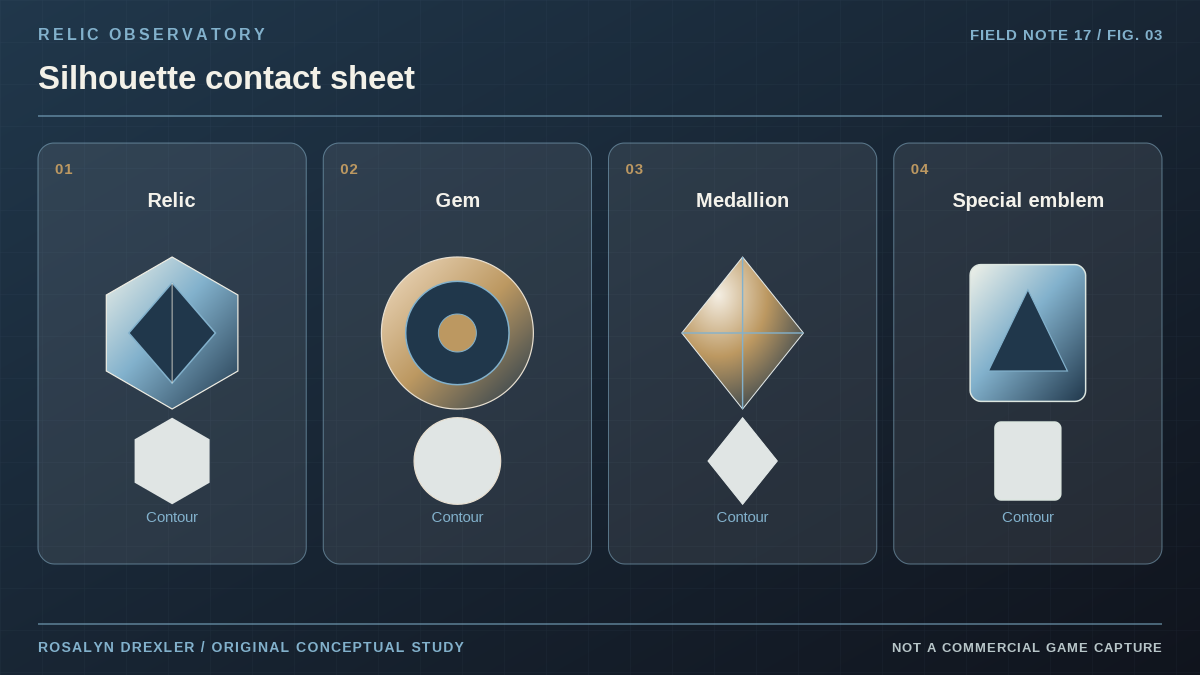
Silhouette. Compare the shape of every object in a monochrome view. This helps reveal whether two assets depend excessively on color or small engravings for recognition. A distinct silhouette can remain useful at reduced dimensions, but it does not replace a functional label where one is necessary. Review objects from the intended camera angle rather than compare unrelated perspectives.
Contrast. Inspect the object against representative display backgrounds and neighboring artwork. Material highlights may become difficult to distinguish when the surrounding composition contains similar reflections. A dark contour may disappear against a dark frame. Compare actual foreground and background combinations, and document required alternative treatments. Do not assign measured contrast scores without checking the rendered values.
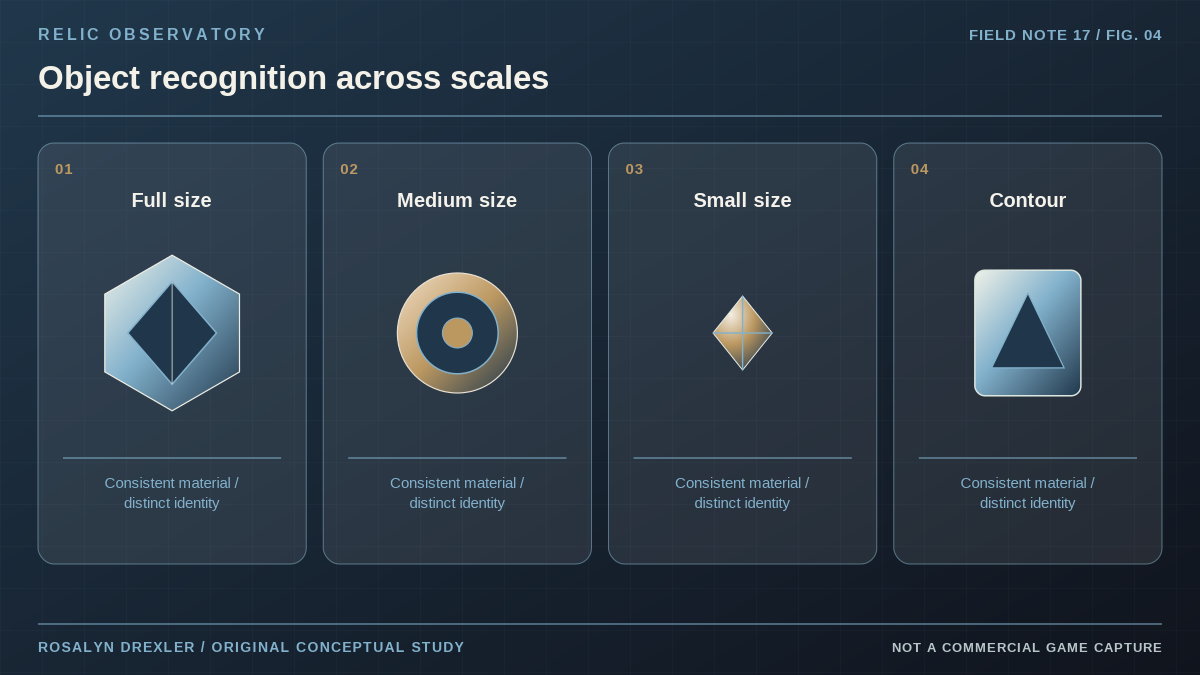
Small-screen scaling. Evaluate the smallest supported object size and the appearance of its essential identifier. Internal decorative details can be simplified in a dedicated export where appropriate, but the established identity should remain consistent. Preserve recognizable proportions, alignment and adequate separation from neighboring objects. A uniform source canvas does not guarantee uniform perceived scale.
Material variation. A shared material vocabulary can provide continuity across different shapes. The same object should retain compatible lighting and geometry when it appears in different supported states. Avoid changing its complete appearance during a transformation without an equivalent state identifier. A production contact sheet can compare full artwork, silhouette and reduced-scale views using the same source assets.
Contextual review. Inspect an ordinary arrangement, a changed symbol state, representative overlapping decorative effects and a simplified presentation. Identify whether object boundaries or functional labels become obscured. If an asset needs an alternate rendering, document which properties must remain recognizable. These reviews are design checks, not evidence of measured user recognition until representative testing is performed.
Silhouette and scale review protocol. Prepare a contact sheet that uses the same source artwork at several actual supported rendering dimensions. Include a monochrome contour view and representative backgrounds. Keep the viewing angle and proportions consistent so that the comparison isolates differences in scale, contrast and internal detail. A source illustration that is recognizable when enlarged may become ambiguous when its identifying engraving is reduced. The review should distinguish a problem with the external contour from a problem with the internal information or surrounding composition.
When comparing different objects, use their actual intended alignment and padding. Two illustrations with the same canvas dimensions may occupy different visual areas because their silhouettes differ. An object with a narrow contour can appear smaller than a rounded object even when the source files have identical dimensions. The art system should document the intended relationship rather than assume that uniform export sizes establish uniform visual weight. Inspect the complete arrangement after applying the actual rendering constraints.
Material and lighting continuity. A shared material vocabulary can be documented with approved specimens and consistent illumination references. For example, brass surfaces may use related highlights and edge treatment, while slate and mineral surfaces provide contrasting texture. The artistic relationships should remain recognizable across different shapes. However, texture density and reflective detail must be considered in relation to functional identifiers. A highly reflective engraving may be clear against one background and difficult to distinguish against another. Review actual combinations within the display and document any required alternate treatment.
The same exercise should include changed presentation states. A transformed object may preserve its baseline contour while introducing an additional indicator. If its appearance changes substantially, verify that the established meaning remains understandable through an explicit identifier or equivalent description. Simplified presentation should retain the relevant information. A decorative reflection or particle treatment should not become the sole remaining marker of the changed state.
Contextual acceptance example. Place the approved objects in a representative complete composition containing neighboring assets, environmental artwork and information labels. Inspect the visual boundaries and the smallest rendered details. Then compare an equivalent simplified presentation. Record which object identity or functional identifier is affected if a problem appears. A useful issue report can distinguish an artwork defect, such as visually similar contours, from an integration defect, such as clipping or an inappropriate background relationship. This makes the required revision more specific and easier to verify.
Symbol QA and handoff checklist
A production handoff should identify the approved visual vocabulary and the technical requirements for each asset. Source files, exported artwork, alignment references and functional identifiers must be distinguishable. Versioning matters when characters, symbols, interface skins and animated effects are produced by different contributors.
Art specification. Include the visual pillars, approved material references, shape families, color relationships and lighting conventions. Record permitted variations and examples of inconsistencies. The broader creative workflow is described in slot game art direction.
Export requirements. Document the actual supported rendering dimensions, transparency, alignment and naming conventions. Avoid assuming one export setting suits every runtime. Inspect alpha edges, clipping, internal padding and consistency of apparent scale. Keep essential state markers separate from optional effects where the implementation supports that distinction.
Quality assurance. Compare each asset with its approved reference and inspect the integrated presentation. Verify distinct silhouettes, readable identifiers, material consistency, small-scale recognition and appearance under alternate motion settings. Test localized labels where relevant. A reported issue should identify the exact asset revision, actual display state, expected meaning and supporting capture.
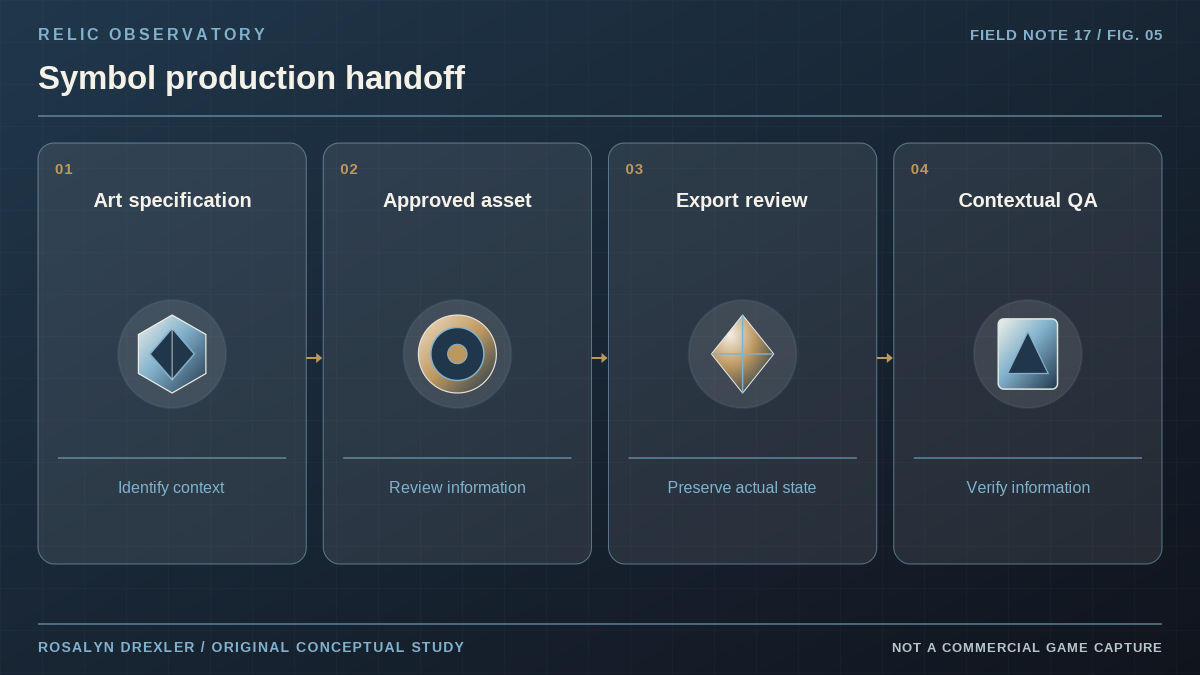
Cross-team review. Art directors, illustrators, UI designers, animators and developers should share the same asset identifiers and state vocabulary. A change in artwork should be reflected in the reference and technical documentation. An accepted source illustration is not necessarily an accepted integrated asset; the latter also requires contextual review.
Technical art handoff record. A production record can include the asset identifier, approved source revision, reference name, source file, export variant, alignment reference, supported display conditions and relevant state identifiers. Actual technical requirements depend on the rendering environment and should be established by the implementation team. Do not infer the required texture dimensions or export configuration from a concept illustration. Review the actual integrated asset to determine whether its edges, transparency and alignment behave as intended.
For an object with several visual states, link each export to its corresponding documented condition. Maintain a separate reference for optional decorative effects. This helps prevent an animation revision from changing the functional identity of an established object. A reduced-motion or alternate presentation may use a different visual treatment, but its essential meaning should remain equivalent. The handoff should document this requirement explicitly.
An acceptance checklist can also identify the person or discipline responsible for the relevant review, without assuming a particular studio's internal workflow. Art direction may approve the visual vocabulary, technical art may review exports and alignment, interface design may inspect contextual information, and implementation QA may verify actual supported states. These responsibilities may overlap depending on the project. The important point is that the approved illustration and the accepted runtime presentation are separate milestones.
Maintain the asset inventory and reference information as the project changes. If a symbol's documented role or name is revised, check the corresponding artwork, functional identifier, reference description and supported state presentation. An isolated asset update can create inconsistency elsewhere if the related documentation is not revised. The final handoff should make these relationships visible and allow the same representative conditions to be inspected after changes. This provides a practical foundation for a coherent symbol system without relying on invented user-recognition or performance scores.
Effective slot game symbol design establishes a repeatable relationship between artistic coherence and distinct functional identities. A well-documented family remains recognizable across supported sizes and states while preserving accurate meaning. The original Relic Observatory examples illustrate that process without assigning financial characteristics to the objects.
Practical design QA checklist
Use this checklist as a review framework; it does not certify accessibility, performance or compliance.