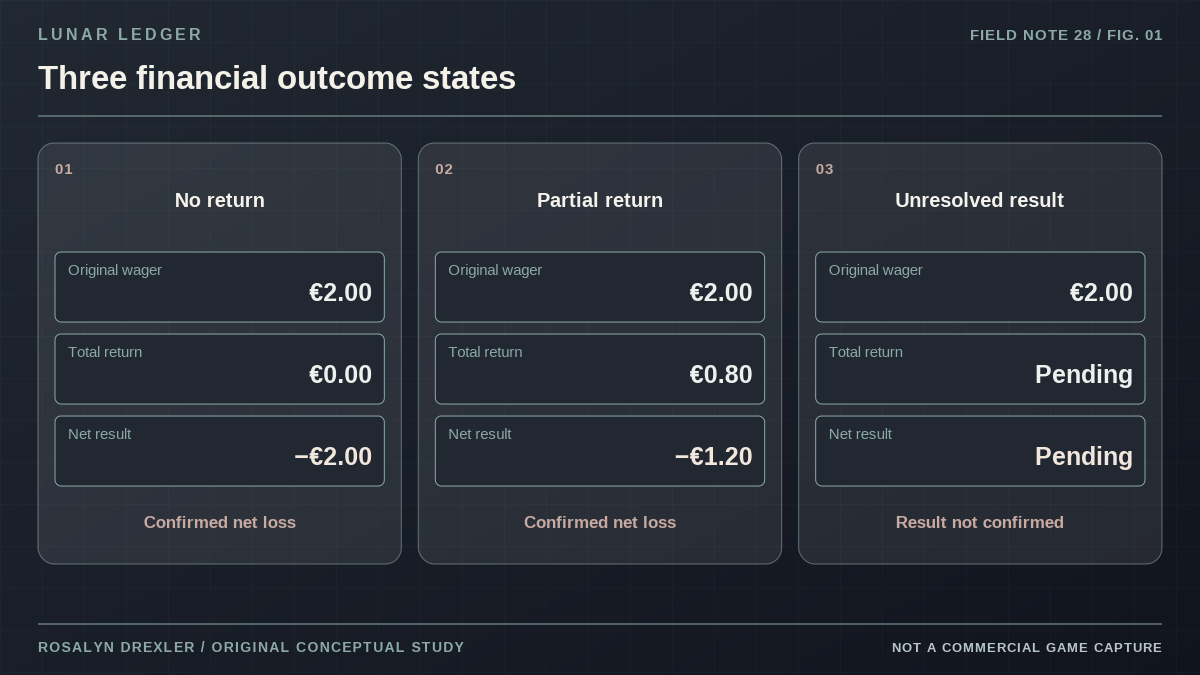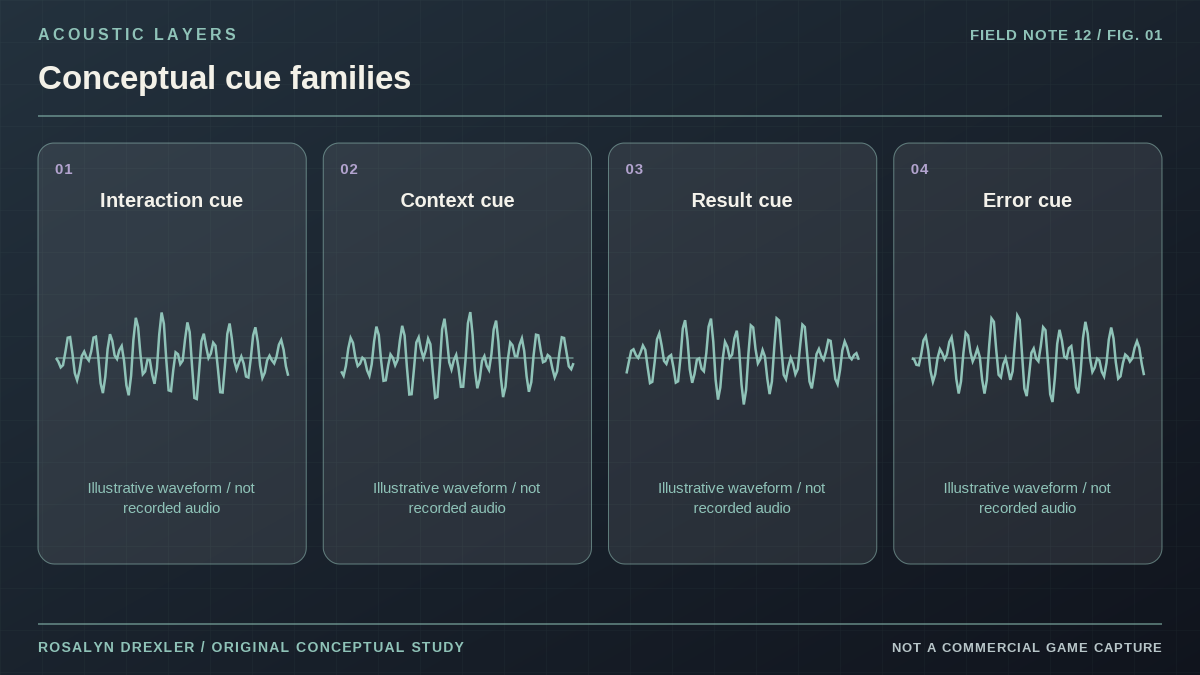
Slot game sound design is an information-design discipline as well as an artistic one. A soundtrack establishes atmosphere, while short audio events can identify presentation changes, confirmed conditions or errors. A sound should communicate a meaning consistent with the information displayed on screen. The Acoustic Layers illustrations describe conceptual cue families and synchronization, not recordings of commercial game audio.
Audio cues across the game loop
A useful audio specification begins with an event inventory. Separate environmental sound, ordinary interaction cues, temporary graphical transitions, confirmed outcomes and unresolved or error states. Each category has a different function. The same sound should not be assigned incompatible meanings across the interface.
Spin, feature entry, result and error states
Spin and feature entry. An interaction sound may acknowledge a control press without confirming that a financial transaction has completed. A contextual announcement may identify a feature state, but its meaning must correspond to established information. The presentation should not imply that a favorable result is already guaranteed. See slot anticipation animations for pre-result cues and their limitations.
Result and error states. An established outcome and an unresolved condition require different communication. Avoid celebratory audio when the net financial result is negative. A returned amount is not necessarily a financial gain. Error feedback should indicate that information is unavailable or an action remains unresolved rather than suggest successful completion. For neutral post-result patterns, see non-winning spin feedback design.
Matching audio to on-screen feedback
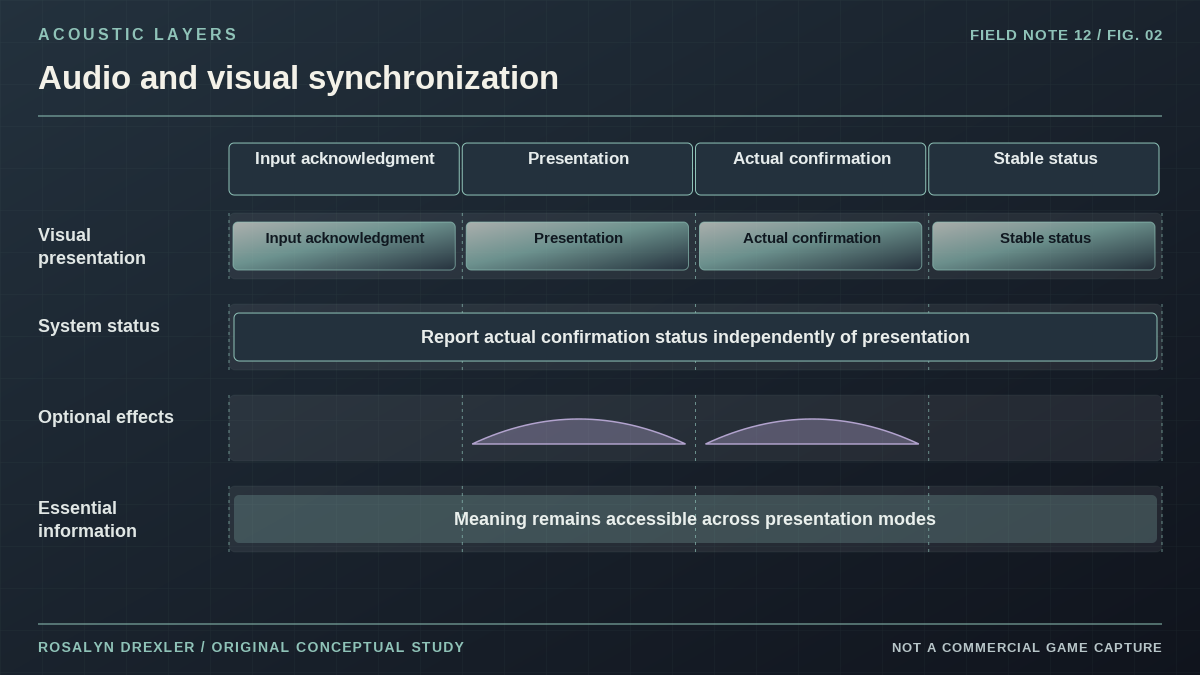
Audio and visual presentation should be specified in relation to the same documented state vocabulary. A sound may occur at a particular point in a graphical sequence, but the animation phase and the actual confirmation status are separate concerns. The specification should identify the information represented by the sound and the corresponding visual or accessible alternative.
Latency, repetition and visual alternatives
Latency. Audio loading, rendering delays and network delays can affect presentation differently. A late or missing sound should not alter the established interface meaning. Test actual synchronization on supported devices rather than assign universal timing values. When an animation is interrupted, the interface should continue to show accurate confirmed information.
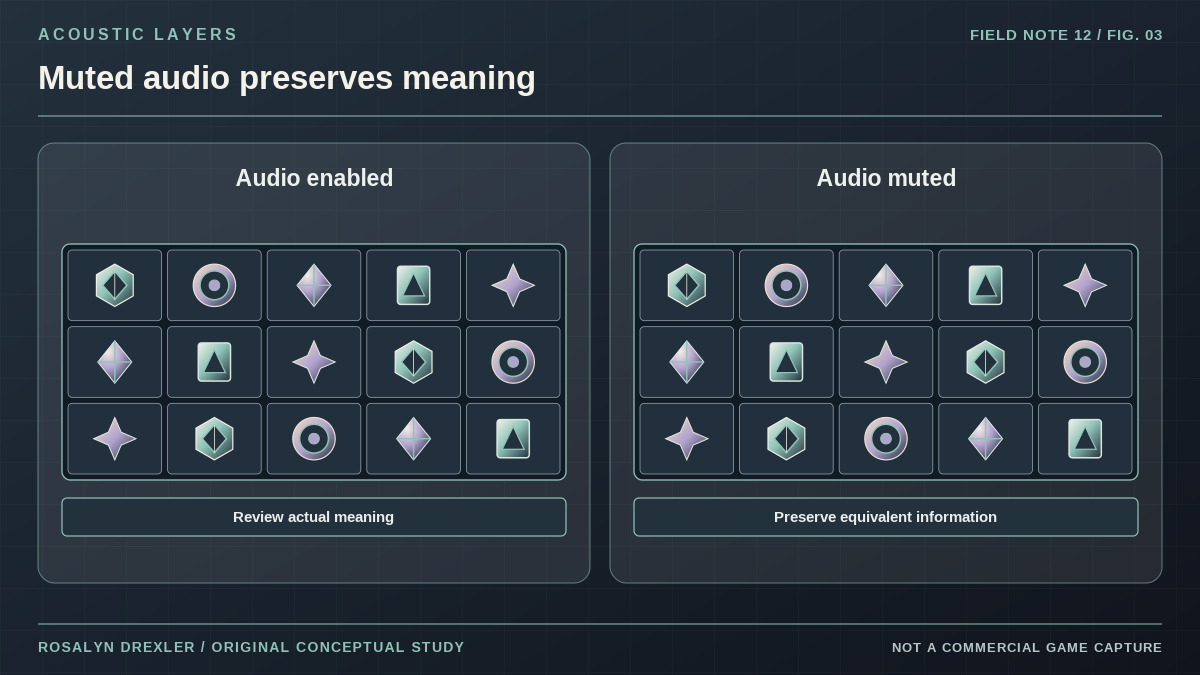
Repetition. A repeated audio event should not obscure more important status information or create inconsistent interpretations. Review simultaneous sounds and the relationship between ambient audio and functional cues. Test whether important conditions remain understandable when sound is muted. A visual status label can communicate essential meaning independently of the decorative soundscape.
Visual alternatives. A sound indicating an unresolved request should correspond to an explicit status, not an unrelated celebratory effect. A completed result should remain available in readable text. The design should not require recognition of a particular musical phrase to understand a financial outcome.
An audio-event reference sheet. A practical specification can contain an event identifier, the corresponding system information, the visible alternative, the audio category and the expected behavior when sound is disabled. For example, a control-acknowledgment event should be documented separately from an established transaction status. A neutral completion cue should not be used as proof that a favorable financial outcome occurred. This separation allows audio designers and UI engineers to share a consistent vocabulary without relying on the artistic interpretation of a sound alone.
Review the event sheet against a representative recorded sequence. Identify the actual visual message associated with each cue. When sounds overlap, determine whether essential status information remains accessible independently of the audio. A conceptual waveform may help describe the presence of an optional cue, but it should not be presented as measured timing or amplitude data.
Sound settings and accessibility
Sound settings should identify which audio categories can be changed and communicate their actual enabled or disabled state. A volume control is not a substitute for accessible visual information. Where the interface supports separate music and effects settings, their names should clearly identify their scope.
A production review should include ordinary states, confirmed negative outcomes, feature transitions, unresolved requests, simultaneous sounds, muted audio and interrupted presentation. Record the actual device, audio configuration and state. Check that alternative modes retain the same financial and contextual meaning. A conceptual waveform is not a recording, and an illustrative timeline cannot establish measured synchronization.
Settings acceptance example. Test the same established negative outcome under ordinary audio settings and with all relevant sound categories muted. The financial labels and explicit result status should communicate equivalent information. If a necessary error or completion state is identifiable only by hearing a cue, provide a supported visual or accessible alternative. Also inspect whether the settings themselves clearly communicate which category is currently enabled. Record the actual device, settings, interface condition and supporting evidence. A successful audio review establishes consistency of meaning across supported modes; it does not require all modes to use identical decorative presentation. Any claims about measured synchronization or resource consumption should be based on recorded implementation evidence rather than a design diagram.
Effective slot game sound design connects artistic identity with consistent state communication. Sound can support a visual presentation, but essential information must remain understandable independently of it. The complete interface should preserve accurate meaning under ordinary, muted and interrupted conditions.
Practical design QA checklist
Use this checklist as a review framework; it does not certify accessibility, performance or compliance.